


Hi, I’m Raffaela — and welcome to AI Leadership Edge for leaders, investors and boards. Make AI your advantage. Turn capital into outcomes.
This issue lands in the middle of a fresh wave of AI-driven layoffs, and the mood in a lot of leadership teams has shifted from “how do we adopt this” to “what does this do to us.” I’ll give you my take on that below, and Thursday’s deep dive goes much further into what it means for how you lead and set up for success.
Regarding setting up for success: Check out our prompting hack #1 and Don’t Miss Ai4 2026 — America’s Largest AI Conference:

Join 12,000+ executives, founders, and investors exploring the breakthroughs, strategies, and market opportunities shaping AI. Dive into AI agents, RAG, MLOps, applied ML, and more — with 400+ exhibits, 1000+ speakers, keynotes from Geoffrey Hinton, Fei-Fei Li, and Andrew Ng, and peer networking. Taking place on August 4–6 at The Venetian in Las Vegas. Register before prices increase at midnight on May 28th to secure your pass and save $1,200+. Register Now.
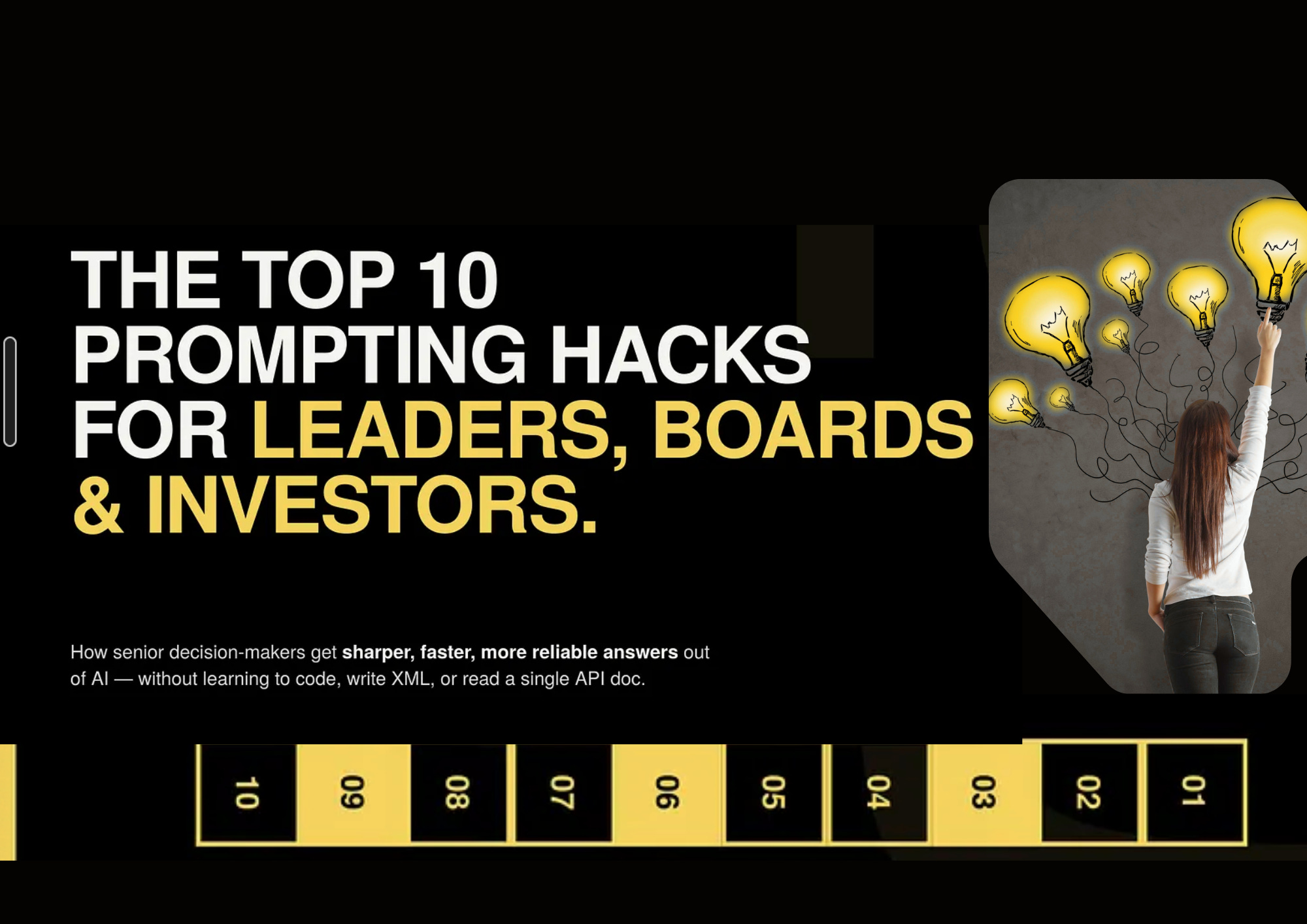
The Top 10 Prompting Hacks for leaders, investors & boards
Most leaders are still under-using AI. Not because the model is wrong, but because the prompt is.
Anthropic’s Applied AI team trains engineers on a 10-layer framework for production prompts. The framework is excellent. It’s also written for engineers shipping code into Swedish car-insurance pipelines. Hence I took the liberty to translate it for people like us ;)
This guide adapts that same framework for a different reader: The CEO who needs to drive AI adoption across the team. The general partner triaging twelve portfolio updates before a Monday IC meeting. The board director reviewing a 200-page board pack on a Sunday night.
None of you will write a line of XML. None of you should have to. But the underlying logic — what the model needs to give you a usable answer — applies just as much to your work as it does to anyone else’s. Possibly more, because the stakes are higher and the time is shorter.
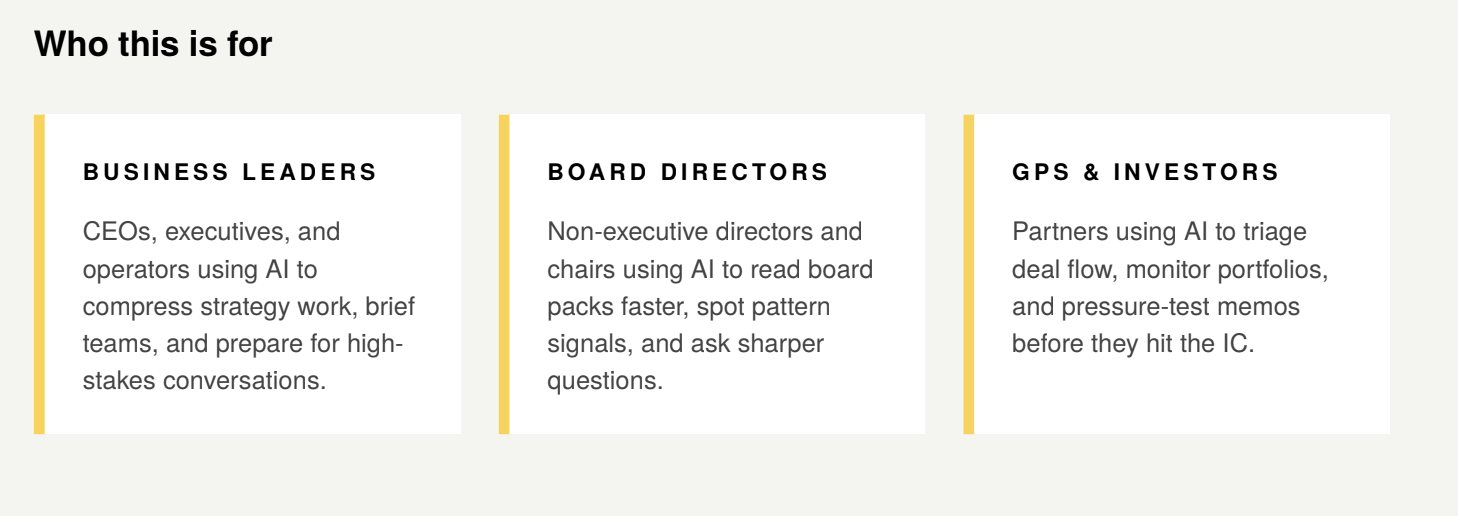
The Framework at a glance
Think of a prompt as the brief you’d give a sharp new hire on day one. Skip the context and they fill the gap with a guess. The model does exactly the same thing.
The lazy version
Summarise this board pack.
The sharp version
You are a senior board advisor with 15 years of experience on Series B+ SaaS boards. I am a non-executive director on the audit committee. I’m reviewing this 80-page board pack before tomorrow’s meeting and need to walk in able to ask three sharp questions of the CFO.
Why it matters: the same model can play “intern” or “former Big Four audit partner” depending entirely on how you frame it. The framing costs you one sentence and changes the entire shape of the answer.
In your seat, if you’re a GP:
You are a partner at a top-decile Series A fund focused on B2B SaaS. I’m preparing for an IC meeting tomorrow on a deal where I have reservations. Read the memo below and tell me the three weakest claims a sceptical partner would push on.
That’s one of ten. The full field guide, all ten hacks plus a bonus framework for stacking them, is free and yours instantly. No referral, no paywall.

From Hierarchy to Intelligence
This was a big week of AI related layoffs, with Meta slashing 8,000 jobs as it bets its future on AI. It's worth remembering Block, under Jack Dorsey, has been among the most vocal in making the AI-driven restructuring argument, which makes their reasoning worth a closer look.
Most companies are using AI as a productivity tool: helping employees write faster, summarize more, or work more efficiently. Block is taking a much bigger view. Their argument is that companies have spent 2,000 years building layers of management to move information through an organization, and AI may now become a fundamentally new coordination mechanism. Instead of simply making existing structures faster, AI could reshape how work gets organized, how decisions get made, and where leverage is created.
Board & Investor takeaway: Most AI conversations start with “Where can we reduce costs?” A more important question may be: “How might AI fundamentally change how this company operates and create leverage?” The biggest opportunity may not be improving existing workflows. It may be redesigning them altogether.
Thursday's deep dive goes further: What does it actually take: What set up, which prerequisites, to start a leaner, AI first organisation, whether you are a small startup or a large enterprise. And how to successfully drive that change. For paid subscribers only. —> Upgrade now!
The Future Technology Company won’t look like a Startup. It will look like Dior.
As AI pushes the cost of building software toward zero, speed and execution may no longer be enough. The argument: tomorrow’s winning companies will increasingly compete on taste, judgment, and the ability to reinvent themselves constantly, more like a fashion house launching new collections than a traditional SaaS company shipping one product. The CEO becomes less of a manager and more of a creative director orchestrating vision, systems, and talent at speed.
Board takeaway: In the AI era, competitive advantage may shift from who can build fastest to who can make the best high-frequency judgment calls.
Investor takeaway: if anyone can build the product, the product is no longer the moat, and that changes what you're underwriting. The edge moves to taste, brand and the founder's ability to keep reinventing, which is harder to diligence and easier to mistake for hype. Be wary of companies whose only advantage is speed; it's the cheapest thing to copy now. The durable question: when this product is commoditised in 18 months, does this team have the judgment to launch the next one?
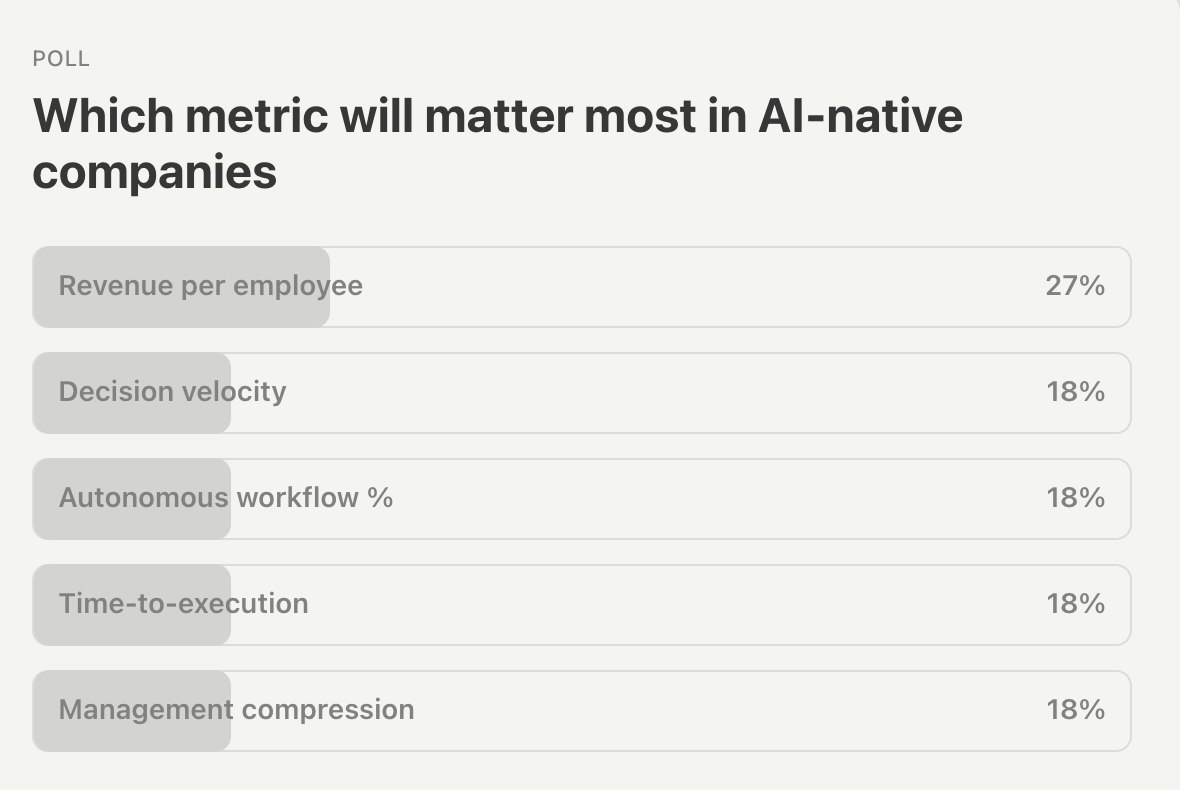
Which metric will matter most in AI-native companies
In last week’s post, I ran a poll on this topic. Here’s how it landed:
The lack of a clear winner is interesting. Revenue per employee is the number investors already reach for, so it's the safe pick. The near-even tie below it suggests we do not know how best to track AI productivity yet.
My bet: decision velocity is the one almost nobody measures today and the one that will quietly separate the winners. You can find examples how companies measure decision velocity in this post —> How to measure AI productivity.
The Director’s Dilemma: When the Most Valuable Thing on the Board is the Thing AI Cannot Replicate
Recent headlines claimed a robot had joined the board of Lloyds Bank. Not quite. Lloyds introduced an AI tool to help directors prepare for meetings, but it does not vote or make decisions. The bigger issue is that many boards are now expected to oversee AI systems they did not build, cannot fully audit, and often cannot fully understand. At the same time, 4 in 10 workers now cite AI-driven obsolescence as a major career fear, and boards are not immune. Fear creates a dangerous side effect: it weakens judgment precisely when judgment matters most.
Board & Investor takeaway: AI may process information faster than any director, but discernment remains human. The board challenge is shifting from “understanding AI mechanics” to preserving independent judgment, curiosity, and oversight while the technology accelerates around us.
UAE CEOs fear AI failure more than AI itself
AI is becoming a CEO accountability issue. Nearly 6 in 10 UAE CEOs say they are under direct board pressure to deliver measurable AI results, while 76% say investors now see AI strategy as critical to performance. Yet 44% have delayed or cancelled AI projects because they fear failure, and 75% believe CEOs could lose their jobs over failed AI strategies or AI-related crises. The leadership lesson: AI risk is increasingly becoming governance risk.
Jobs of the week

President, AI Acquisition - Remote
Member of AI Advisory Board - CISO/ CIO, Andeavour, Remote
Principal, AI Leadership Practice, The Forward Institute, London
Director, AI Enablement, CoinDesk, New York
Head of AI Productivity Lab, Lloyds Banking Group, UK
Head of Internal AI, User Testing, Remote (US / UK)
Project Manager (Part time) and AE/Sales VP, QueryPal, Remote
If you’d like us to include your jobs in the next issue for free, message us here
Post of the week
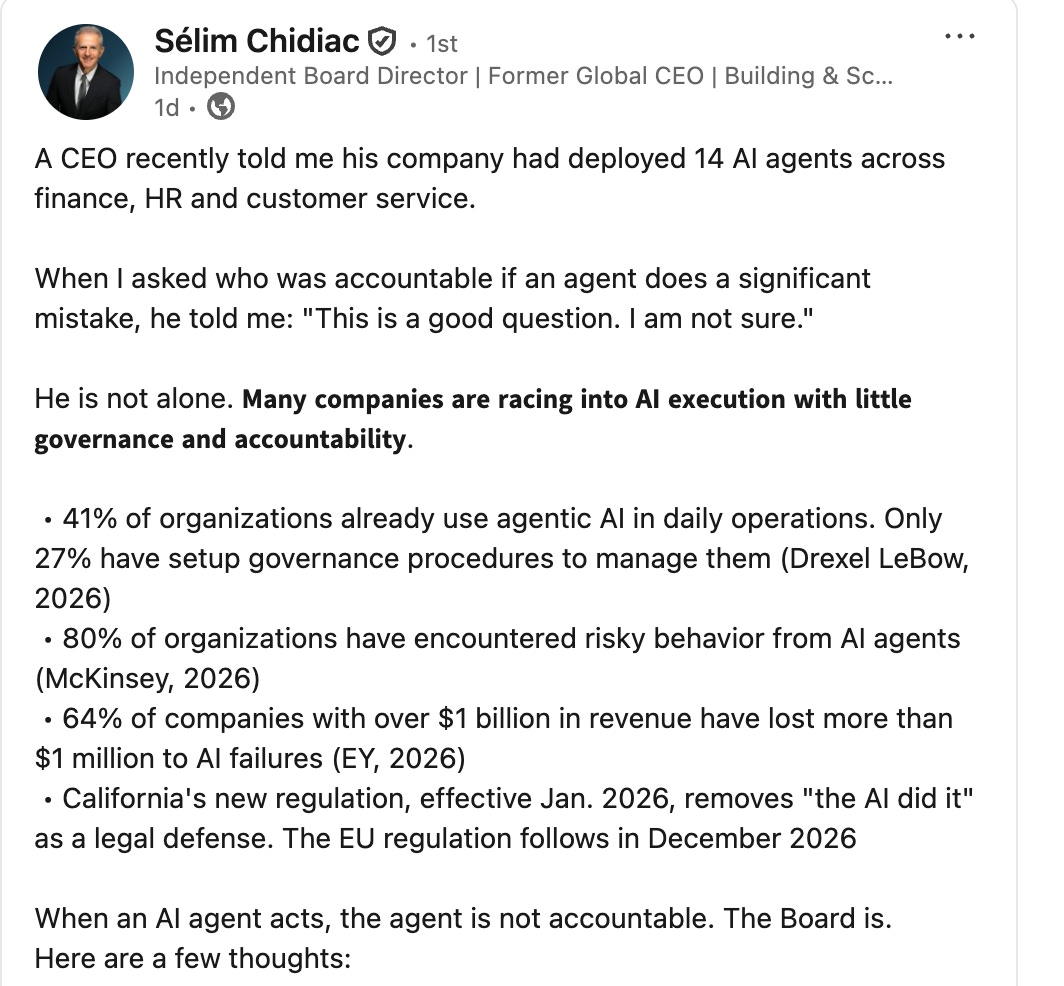
If AI makes a serious mistake, who in your organisation is accountable for it?
The answer, that the agent never is and the board / leadership team always is, is the cleanest articulation of AI-as-governance-risk I've seen this week. See full post.
🎁 Enjoying The AI Leadership Edge?
Paid subscribers get a premium deep dive every Thursday (this week: How to actually cut middle management with AI), plus the AI Boardroom & Leadership Toolkit and the full archive.
Refer a friend and get the Executive Meeting Toolkit: 5 frameworks for the meetings you run every week. [Refer a friend →]
A thanks to our partners:
BoardLens, the AI super analyst for fund partners and board directors. It reads everything they don't have time to, tracks every commitment management makes, surfaces what's drifting before it becomes a blowup, and prepares the sharper questions that make them the strategic sparring partner the CEO actually wants to call
Chronicle Labs Find and stress test agent failures before your customers do, using operational data to replay production-like scenarios.
Ai4 2026 Join 12,000+ peers at Ai4 2026 on August 4-6 in Las Vegas to explore the real-world applications of AI Agents, World Models, and more alongside pioneers like Geoffrey Hinton, Fei-Fei Li, and Andrew Ng. Register now
Read more from the AI Leadership Edge
How to track AI productivity Everyone claims AI productivity gains. Almost nobody can measure them.
The AI Stress Test Every Leader Should Run 6 prompts to stress test your AI strategy across execution bottlenecks, talent and team risks, strategic and competitive blind spots and more.
The Top 10 Books for leaders, directors and investors Required reading for boards, the truth about productivity, AI’s macro disruption unpacked — and a viral reminder of how not to run an AI transformation.
The Advisory Board Squeeze (And Why AGI Is Closer Than You Think) Does Your Advisory Board Make You Uncomfortable? Becoming AI fluent investor edition and the napkin test for leadership gaps