


Hi, I’m Raffaela — and welcome to AI Leadership Edge, a newsletter for business leaders, boards and investors who want to gain leverage with AI.
This newsletter is powered by BoardLens, the AI analyst for fund partners and board directors. It reads everything they don't have time to, tracks every commitment management makes, surfaces what's drifting before it becomes a blowup, and prepares the sharper questions that make them the strategic sparring partner the CEO actually wants to call.
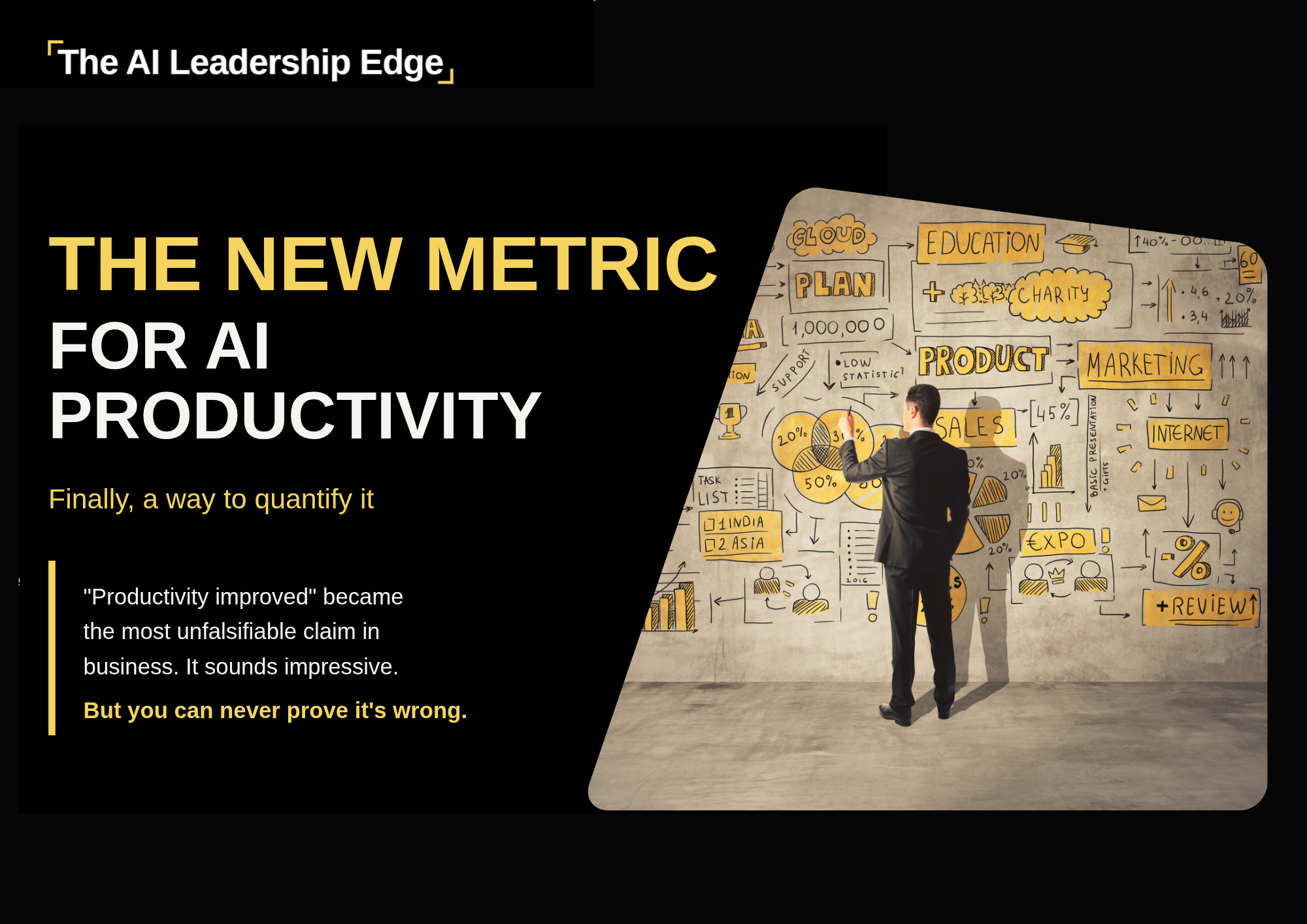
An AI productivity report should show what changed in the business. Choose a workflow, establish its baseline, and measure the quality, cost and time required to produce an accepted result. Then distinguish released capacity from savings that have reached the financial statements. This scorecard offers ten measures; select the few that match the company’s operating priorities.
Updated 22 September 2026: clarified measurement definitions, corrected reporting-level counts and reformatted the tracking templates.
Every company says AI is improving productivity.
Few can explain exactly where.
Fewer can quantify it.
And almost nobody can distinguish real organizational leverage from temporary efficiency “theater”.
That’s because most companies are measuring AI productivity at the wrong layer.
They measure:
prompts used
hours saved
copilots deployed
employee usage rates
tasks completed faster
These are activity metrics.
Not transformation metrics.
The real productivity gains from AI happen at the organizational level.
The companies that win in the AI era will not simply do the same work faster.
They will redesign how work happens entirely.
The Top 10 Prompting Hacks for leaders, investors & boards
Prompting is becoming one of the most important leadership skills of the AI era. The Top 10 Prompting Hacks for Leaders, Boards & Investors is a practical guide to getting better answers from AI.
The Old Productivity Model
For decades, productivity scaled mostly through one thing:
More people.
More analysts.
More managers.
More coordination.
More meetings.
More layers.
Traditional organizations grew like pyramids because human coordination was the bottleneck.
If output needed to increase, companies added headcount.
That model shaped almost every management system we still use today.
AI breaks this logic.
Because AI dramatically reduces the coordination cost of execution.
One highly capable operator with AI support can now perform work that previously required entire teams.
This changes the economics of organizations.
And it changes what productivity actually means.
The New Productivity Metric
The companies creating the most value from AI are not necessarily the ones deploying the most AI tools.
They are the ones increasing organizational leverage.
The new metric is not:
“Are employees using AI?”
The new metric is:
How much output can the organization generate per unit of coordination?
That changes everything.
Because coordination is what slows companies down:
meetings
approvals
reporting layers
information bottlenecks
management overhead
cross-functional dependencies
AI compresses those costs.
Which means the highest-performing companies in the next decade may look fundamentally different:
smaller teams
fewer management layers
higher revenue per employee
faster decision cycles
more autonomous operators
dramatically lower coordination overhead
Example: One AI-native company compressed decision velocity from 28 days to 2 days—14x faster from problem identified to solution shipped. More on how they measured this can be found in the section for paid subscribers.
The Shift Most Leaders Miss
Most AI initiatives focus on local productivity.
“How do we help employees work faster?”
But the biggest gains come from system redesign.
Not task acceleration.
The companies that outperform will rethink:
team structure
management layers
workflow ownership
decision rights
operating cadence
communication systems
The best boards track 10 specific metrics that separate transformation from theater—revenue per employee, decision velocity, autonomous workflow percentage, and 7 others. [Full scorecard for paid subscribers below.]
AI is not just a software upgrade.
It is a management revolution.
And most organizations are still measuring it with industrial-era metrics.
The New AI Productivity Stack
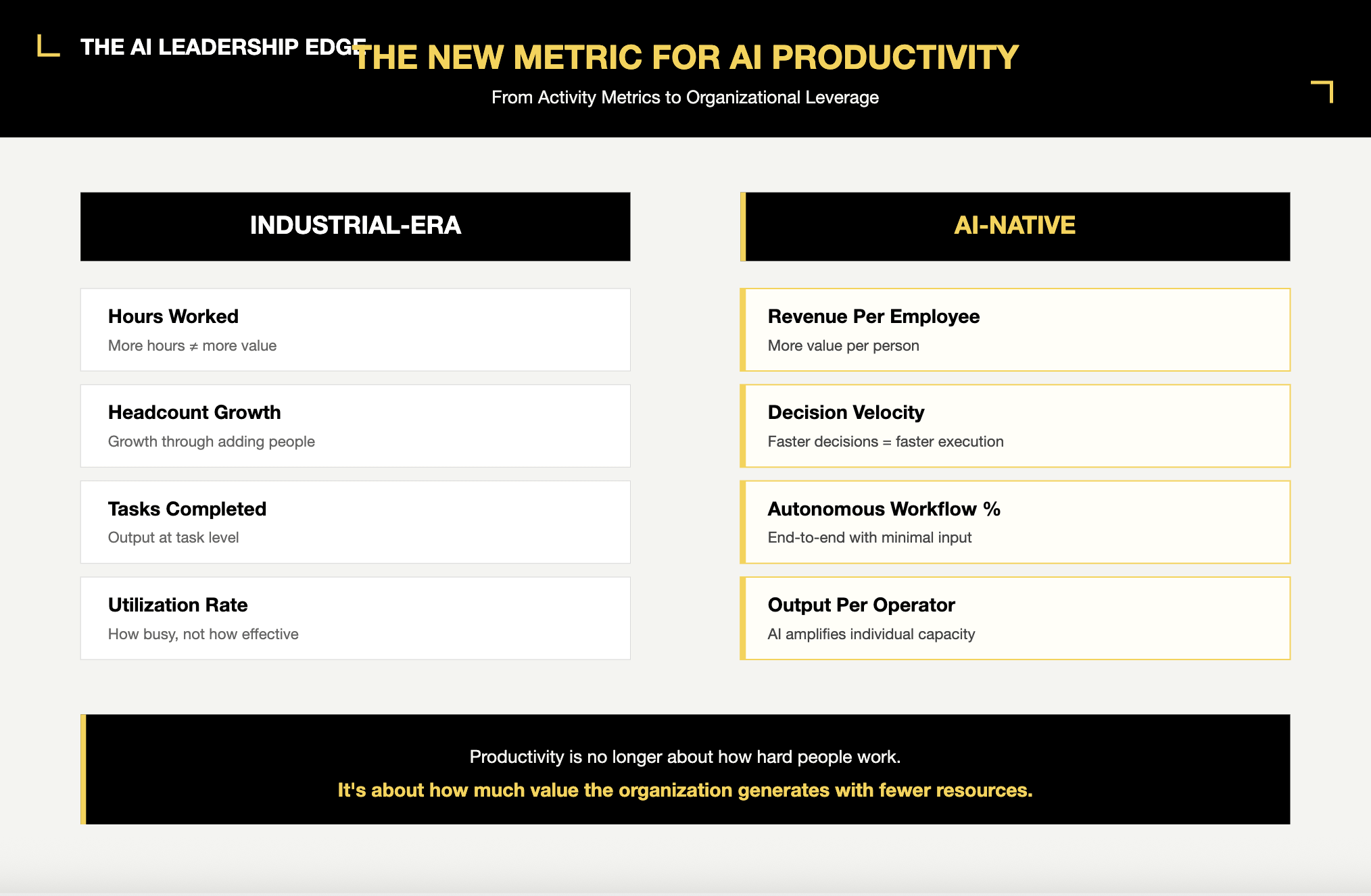
What Boards Should Actually Track
Boards asking:
“How many employees are using AI?”
are asking the wrong question.
The better questions are:
Has decision velocity increased?
Has revenue per employee increased?
Are management layers compressing?
Is execution becoming faster?
Is coordination overhead falling?
Can smaller teams now create disproportionate output?
Each of these is measurable. The AI Productivity Scorecard for paid subscribers below shows exactly how.
Because in the AI era, productivity is no longer mainly about labor efficiency.
It is about organizational leverage.
That is the real shift.
Boardroom Takeaway
The companies that win in the AI era will not necessarily have the best models.
They will have the operating systems that create the most leverage per person.
And that is a very different kind of company than the world has historically rewarded.
🔒 The AI Productivity Scorecard
Most leaders and boards track AI adoption, training completion, and tool usage.
None of those metrics tell you if AI is actually changing how the business operates.
The scorecard below shows the 10 metrics AI-native companies track internally to measure organizational leverage, not activity theater.
Each metric includes:
How to calculate it (exact formulas)
Real before/after case studies
Implementation templates
Suggested planning targets, to be tested against your own baseline
One company used metric #2 (Decision Velocity) to compress execution cycles from 28 days to 2 days. Another used metric #5 (Output Per Operator) to increase sales productivity 75% without adding headcount.
If you’re on a board, managing a portfolio, or leading AI transformation, this is the measurement system you need. Available to paid subscribers
A thanks to our partners:
BoardLens, the AI intelligence platform for board directors and investors- Effectiveness redefined for all post -investment and board work.
Chronicle Labs Find and stress test agent failures before your customers do, using operational data to replay production-like scenarios.
Ai4 2026 Join 12,000+ peers at Ai4 2026 on August 4-6 in Las Vegas to explore the real-world applications of AI Agents, World Models, and more alongside pioneers like Geoffrey Hinton, Fei-Fei Li, and Andrew Ng. Register now
Read more from the AI Leadership Edge
The New Metric That Redefines Companies AI-compressed orgs, skyrocketing revenue-per-employee, synthetic boards, and a venture world where attention beats money.
The AI Stress Test Every Leader Should Run 6 prompts to stress test your AI strategy across execution bottlenecks, talent and team risks, strategic and competitive blind spots and more.
The Top 10 Books for leaders, directors and investors Required reading for boards, the truth about productivity, AI’s macro disruption unpacked — and a viral reminder of how not to run an AI transformation.
The Advisory Board Squeeze (And Why AGI Is Closer Than You Think) Does Your Advisory Board Make You Uncomfortable? Becoming AI fluent investor edition and the napkin test for leadership gaps
